25
AI Products & Systems Built
This section highlights Pickahroo, FixPixie, and AutoSite AI as examples of applied product thinking across consumer, repair, and publishing workflows.
Portfolio
Lorraine Dukes designs AI-assisted products and operating systems for messy, reviewable workflows: inputs become structured drafts, people make the judgment calls, and approved outputs become operational records.

25
This section highlights Pickahroo, FixPixie, and AutoSite AI as examples of applied product thinking across consumer, repair, and publishing workflows.
HITL
Drafting, recommendation, and publishing flows keep important decisions visible, reviewable, and approved by people.
Ops
Operating guides, source hierarchies, approval gates, and workflow rules support safe adoption beyond the interface.
14+
A systems UX foundation across product, service, accessibility, data, and operational workflows.
AI operations capabilities
Reframing scattered inputs, handoffs, and approvals into structured product workflows.
Defining when AI can draft or recommend and when a person must approve, revise, or stop the flow.
Creating source-of-truth rules, prompt boundaries, escalation paths, and usage constraints.
Designing reference systems that both teams and assistants can use without conflicting instructions.
Separating draft generation from final publishing so content stays inspectable before release.
Making uncertainty, safety boundaries, fallback states, and human judgment part of the product experience.
Featured AI operating model case study
A human-readable and AI-readable operating source of truth for campaign assistance, brand rules, content boundaries, image-fit review, tool usage, and final approval.
The case study demonstrates how an AI product can be governed before it generates: source hierarchy, assistant scope, permission-first language, revision paths, and human approval are part of the operating model rather than after-the-fact review.

AI PRODUCT UX CASE STUDY
Pickahroo is a mobile-first harvest-sharing prototype for two primary users: tree owners who want to identify, list, and share backyard harvests, and local pickers who want to gather or buy local food nearby.
The UX strategy differs from public foraging maps by bringing the tree owner into the marketplace. Instead of treating fruit trees as anonymous points on a map, Pickahroo gives owners a way to identify what is growing, decide whether it is worth sharing, review picker interest, and control when pickup details are shared.

AI Systems Case Study
An API-first structured output and review workflow behind AutoSite AI.
AutoSite AI API handles request context, applies rules for structured output, and returns reviewable content that can be rendered by a front end. The design response focuses on predictable payloads and human review rather than uncontrolled generation or unsupported production-doc claims.
AI Publishing System
A structured content-generation and publishing workflow for turning business inputs into reviewable website content.
AutoSite AI turns business context into AI-created draft sections that a person can inspect, revise, and approve before website content is published. The design challenge is to keep the generated site structured and editable rather than treating AI output as an opaque final page.
AI Triage Case Study
A consumer AI guidance product that helps users interpret home repair needs from photos and turn them into practical next steps.
FixPixie frames photo input as a triage workflow: AI can help interpret visible repair context, but safety checks shape whether the next step is DIY guidance or professional escalation. The response is a conservative decision-support pattern that turns uncertainty into reviewable, practical guidance.
AI Design Systems
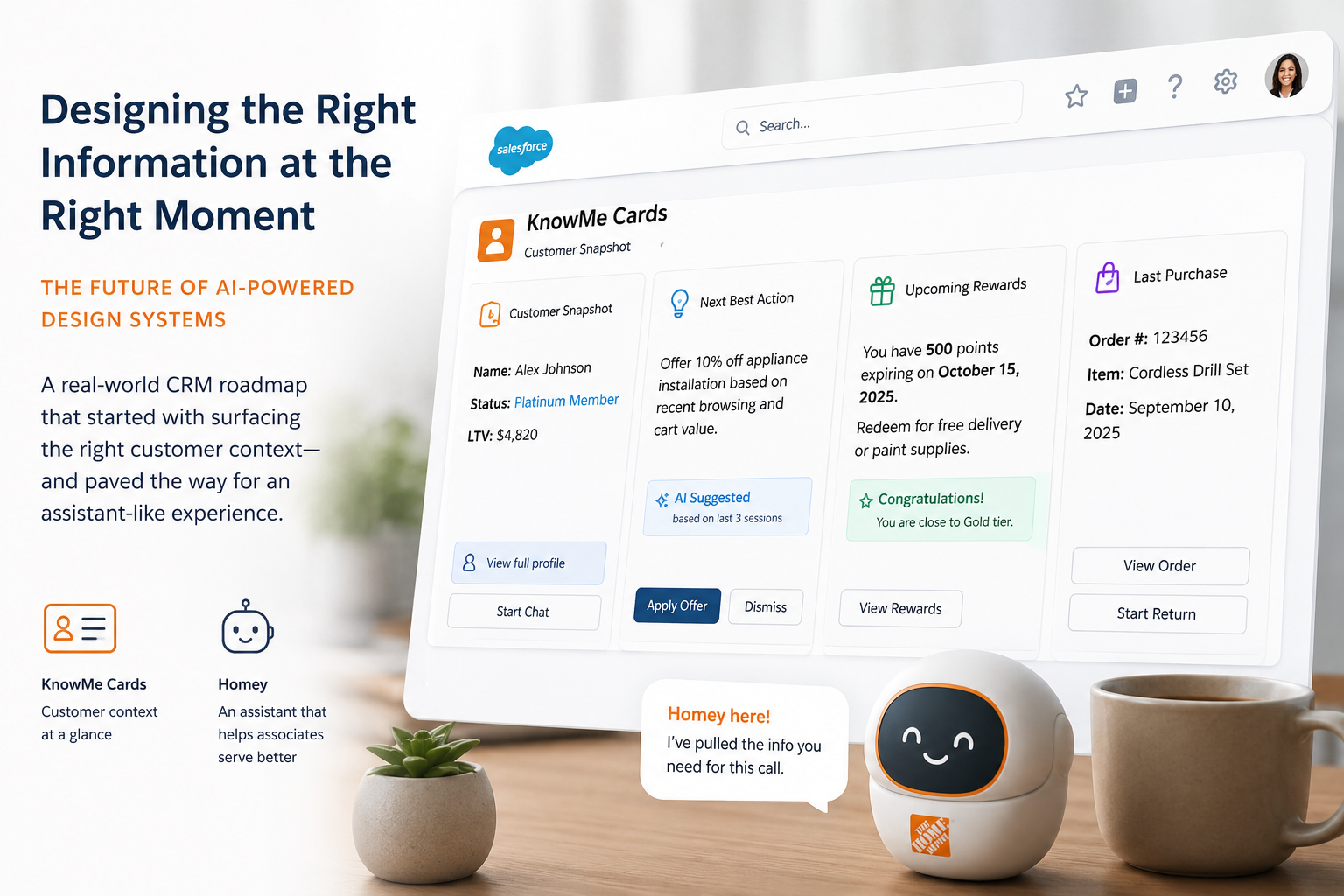
Early AI-readiness and assistant-ready CRM strategy for surfacing customer context inside service workflows.
This case study positions the CRM work as part of an AI product and systems foundation: not AI-generated components, but the information architecture, component strategy, and workflow governance needed to prepare a service experience for future assistant-supported workflows. The adoption flow centers on data readiness, governance baseline, and architecture and pilot work, with use case discovery as a supporting layer before any scaling pipeline.
Broader experience
This focused page highlights AI product and operations work. My broader background includes enterprise UX, Salesforce systems, accessibility, compliance, data strategy, service design, and workflow design from prior product and consulting work.
View broader portfolioSome products are live, some are prototypes, and some are still being refined. This page emphasizes product thinking, interaction patterns, workflow strategy, and operating model design rather than unsupported performance claims.
Quick links
A short set of links for referrals, hiring conversations, consulting conversations, and partnership discussions.